The short answer
Hinge has no screenshot detection anywhere. Capture a profile, a prompt answer, a photo, a whole chat thread or a voice note screen, and the other person receives nothing: no icon, no message, no entry in any list. Screen recordings are equally invisible. This is not an oversight Hinge might fix next update; it is the standard across the category, as the table below shows.
Surface by surface
| You screenshot… | Does the other person find out? |
|---|---|
| A profile, photos and prompts | No |
| A match's chat thread | No |
| A voice prompt or voice note screen | No |
| Your own likes and comments screens | No |
| A video chat | No notification; recording etiquette still applies |
Every dating app made the same choice
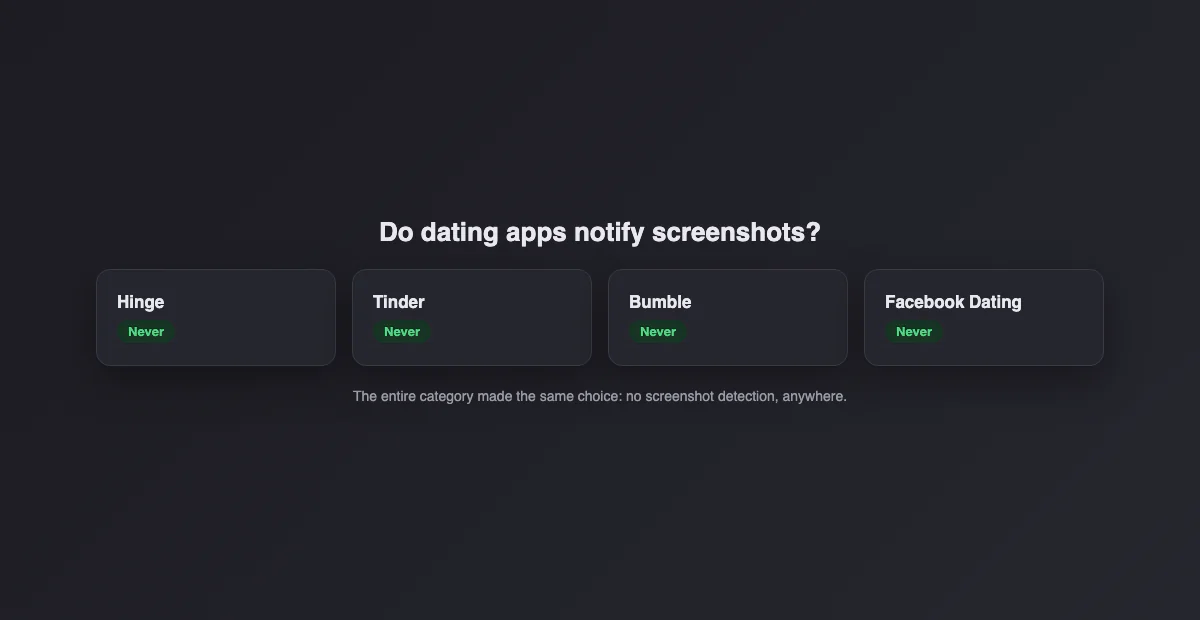
Hinge is not the exception; it is the rule. Tinder, Bumble and Facebook Dating all ship without screenshot detection on any surface, which makes dating the most uniform category in the entire who-gets-notified landscape. The likely reason is practical: screenshotting is so woven into how people use these apps (see the next section) that alerts would fire constantly and mean nothing. Whatever the motive, the takeaway is symmetrical: nobody learns about your captures, and you never learn about theirs.
The group chat is part of the process
Half of all dating app screenshots exist so a friend can weigh in. Profile screenshots flow into group chats for vetting, funny prompts get shared, red flags get second opinions. That is normal, silent, and by most people's standards fair play within a trusted circle. Where the consensus flips is publication: posting a stranger's profile publicly (with their name, face and workplace attached) turns vetting into exposure, and that ethical line exists independently of any notification system. Screenshot freely; publish never.
The safety case: capture before you unmatch
The single most practical fact on this page: on Hinge, unmatching deletes the conversation from your view, and so does being unmatched. If a chat turns manipulative, scammy or threatening, the moment to screenshot is before you unmatch, block or report, while the evidence is still on your screen. Safety guides and Hinge's own reporting flow work far better with captures in hand: names, payment requests, threats, timestamps. The order of operations that protects you: screenshot, report, then unmatch. Reversing it destroys the record.
Romance scams run on urgency; screenshots run on patience
The classic scam arc (fast affection, a sad story, a payment request, a push to move off the app) depends on you acting quickly and alone. Screenshots break both levers: capturing the conversation for a friend's second opinion adds the outside eyes scammers route around, and a captured payment request is exactly what platform reports and, when it gets that far, police reports are built from. If a match ever asks for money, the screenshot is not rude; it is the correct reflex.
Your own profile is capturable too, plan accordingly
Symmetry cuts the other way: anyone who sees your profile can capture it silently, and dating profiles travel further than people assume, into group chats you will never see. The practical calibration: keep identifying specifics out of the profile itself (exact workplace, street, plate numbers in photos, kids' schools in the background) and treat prompts as public writing. None of that is paranoia; it is writing for the actual audience, which includes every match's group chat.
Video dates and voice notes
Hinge's calls carry no capture detection either, and the same second-phone reality applies as everywhere: no app can ever prove a call was not recorded. The reasonable norms are the human ones: assume a first video date could be captured, keep it accordingly, and extend the same courtesy in reverse. For voice prompts on profiles, remember they can be screen-recorded with audio in two taps, so the same public-writing rule applies to public speaking.
How dating apps compare with everything else
Zoom out and the dating category sits at the silent end of a spectrum. Snapchat notifies almost everywhere; Instagram blocks captures of disappearing DMs outright; WhatsApp blacks out view-once media; TikTok and every dating app, Tinder and Bumble included, report nothing at all. Knowing which regime you are in is the entire game, and on Hinge the regime is: silence, both directions.
What Hinge does tell the other person
For contrast, the signals that do exist. Your like and the comment on it arrive with your name, obviously. A match notifies both sides. Messages arrive as notifications, but Hinge ships no read receipts: nobody can tell you opened a message and chose silence, which does more for guilt-free browsing than any screenshot policy. There is no "viewed your profile" feed either; being seen in Discover is anonymous. The full visible surface is what you actively send, and nothing you quietly do.
If you are capturing to report: do it usefully
Evidence captures work best with three habits. Get the profile itself, not just the chat: name, photos, prompts, since the profile disappears from your view after unmatching. Capture with context visible: whole messages with the thread order intact, rather than one cropped bubble that could mean anything. And keep the set together in an album until it has been through Hinge's report flow, which accepts details and screenshots, and through any escalation you choose. The one-line version stays the same as above: everything first, unmatch last.
The built-in alternative: sharing a profile without capturing it
For the vetting use case, Hinge quietly ships a sanctioned route: the three-dot menu on any profile has a Share this Profile option that produces a link. The differences from a screenshot cut both ways. The link shows the live profile (so your friend sees more than one frame), it stops working if the person deletes their account, and it involves no image sitting in anyone's camera roll afterward. The screenshot remains better as a record; the share link is better as a question, and knowing both exist lets you pick by intent.
If a screenshot of you gets misused
The notification question ends at capture, but recourse does not. A profile posted publicly to mock or expose you violates most platforms' harassment rules: report it on the platform where it appears, and report the source match on Hinge, where profile misuse is a reporting category. For impersonation (your photos on someone else's profile), Hinge and the photo platforms both take takedown reports. Captures being silent does not make misuse consequence-free; the enforcement just lives downstream.